Interviews
A Word With Nico Köhs
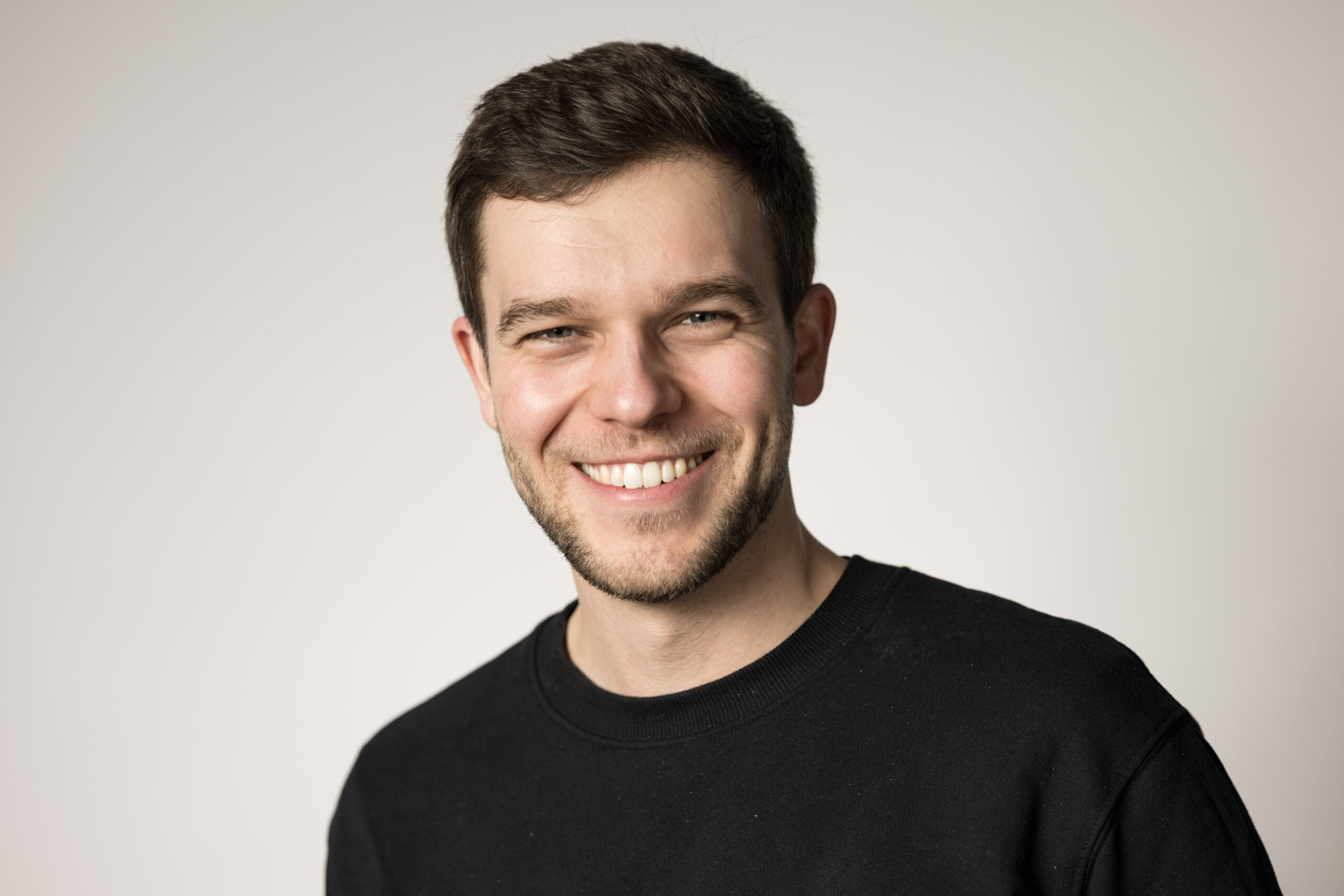
Since January 2026, Nico Köhs has been Assistant to the Chief Conductor at the Rundfunkchor Berlin. In this interview, he talks about the moment he truly felt at home with the choir, why the Schola is about far more than musical training – and how a concert about transience can still leave you feeling affirmatively alive.On Sunday 4 October, he will conduct the Schola in concert at the Heilig-Kreuz-Kirche. Together with members of the Rundfunkchor Berlin, the young singers will perform a programme ranging from Purcell to Sandström: music about consolation, loss, hope and the question of how we live with the fact that our time is limited.
You’ve now been Assistant to the Chief Conductor for about nine months. When did you first feel: Right, I’m properly here now?
It was more of a gradual process, really – and it had a lot to do with the preparations for Henze’s Symphony No. 9, in February, May and then again in September. In February and May, I was able to work with the choir at the piano, which was an incredibly demanding task. It also meant I spent a great deal of time close to the choir, accompanying them from the piano. By the revival in May at the latest, I thought: okay, I’m part of this production now – and part of this choir. Then there was the RundfunkchorLounge in April, where I was able to conduct myself. These days, I really do feel at home here – certainly since the start of the new season in August.
What have you learnt about the Rundfunkchor and its singers that people on the outside probably wouldn’t expect?
They are people, after all! When you are sitting in the audience, perhaps at the Philharmonie, everything can seem very formal: the men in tailcoats, the women in evening dress. The art itself is so present – perhaps even before you notice the people in the choir. But everyone here is incredibly open and kind, and they made me feel welcome very quickly. That was a wonderful feeling, because of course there is a real sense of awe when you stand in front of this choir – especially when you think about all the people who have stood there before you. For me, the choir manages to combine absolute professionalism with genuine warmth, and that is by no means a given. It is the most lovely thing I have discovered here.
What would you like to give the Schola participants during these intensive days that they cannot simply learn from sheet music, technique or conservatoire seminars?
It is a new group, put together from all sorts of places. The participants come from across Germany and from very different music colleges. Bringing those individuals together over just a few days and creating a new group with a shared sound – musically, of course, but also in the breaks between rehearsals – is a special challenge. There is an extraordinary energy in that. This kind of choral music brings people together, and I hope they will stay in touch afterwards too. If I can help make that happen, that would be the best possible outcome.
What do you notice when the Schola singers meet the Rundfunkchor?
In those first few minutes, you could immediately sense a huge amount of respect for the choir. They are sitting alongside very experienced singers and making this music with them. At the same time, they are highly motivated and very well prepared. They know what lies ahead: the Schola concert, as well as the concerts at the Philharmonie. Those two weeks are incredibly intense, and they offer the chance to gain important experience. It was already exciting to see that at the first Schola rehearsal yesterday. I felt something similar when I first came into this building: you feel quite small and think, this is a palace of choral music. And then you realise that ordinary working life happens here too – albeit under very professional conditions.
The programme spans a wide arc, from Heinrich Schütz to Sven-David Sandström. Despite the centuries between them, what connects this music for you?
It deals with deeply human themes: transience, death, and the question of what happens after life. These are things that have always moved people and inspired them to create art. Schütz’s »Unser Wandel ist im Himmel« asks what becomes of us after death. In Howells, there is the immense grief surrounding the assassination of John F. Kennedy in 1963. For me, that is the thread running through all these pieces: how do we deal with the limited time we have? What does that mean for us personally, for the people around us, and perhaps for the planet we live on? In Sandström’s »In paradisum«, I hear the suggestion that perhaps there is a paradise after life. But really, we can find it on our doorstep too, if we look for it. The piece also asks what drives us to long so strongly for a life beyond this one, while perhaps not caring for our immediate surroundings as thoughtfully as we could.
Is there a particular highlight in the programme, or a moment you are especially looking forward to?
I think the whole concert will be special, simply because it is my first with the Rundfunkchor Berlin’s Schola. I love Herbert Howells’s piece. It is extraordinary and intense – full of despair, but also full of consolation. Then there is William Harris’s double-choir piece »Faire is the Heaven«, which describes the beauty of heaven and the angels, archangels, seraphim and cherubim to be found there. Those are the two works I am especially looking forward to.
The concert touches on all the themes you have just mentioned: consolation, loss, hope and remembrance. As a conductor, how do you open up those emotional spaces without explaining them away?
In rehearsal, it can be helpful to talk things through – but not in the concert itself, of course. If you have managed during the preparation process to uncover what the music means on a personal level, a completely different connection develops with the group in front of you. Then, in performance, a great deal can grow out of the moment itself – often non-verbally. Whether it happens is sometimes down to chance as well. But when it does work, it is especially beautiful.
The Heilig-Kreuz-Kirche has its own atmosphere; it is not a conventional concert hall. What does performing there change for you?
I always find it special to make music in churches. I would not necessarily describe myself as particularly religious, but I feel a strong connection to church spaces and to Christian values, even though I do not go to church regularly. When I have the chance to make choral music in places like these, I always feel that it helps the music – particularly sacred music, and we have quite a lot of that in the programme. The acoustics are different; the light is different. It changes something for the audience too when the choir stands in front of the altar or in the chancel: there is that high ceiling, reaching symbolically towards the sky. All of that can make a concert feel truly special.
What thought or feeling would you like people to carry with them as they step back out onto Blücherplatz after the concert?
It is always difficult to predict, because people come to a concert from very different situations in their lives. I hope there will be something for everyone, something that speaks to their own personal circumstances. If they leave feeling more comforted than when they arrived, that would be wonderful. Or perhaps it is that defiant sense of saying yes to life, even when someone close to you may be nearing the end of theirs. What matters is the change between before and after. If people leave feeling lighter than when they came in, then we will have achieved a great deal.
If you had to promote the Schola concert using three images, colours or feelings rather than composers’ names, what would they be?
Only three? [laughs] Defiant, life-affirming and deeply reflective.