





»Remember Not, Lord, Our Offences« Z50 (1679–81)
Anthem for five-part choir and basso continuo
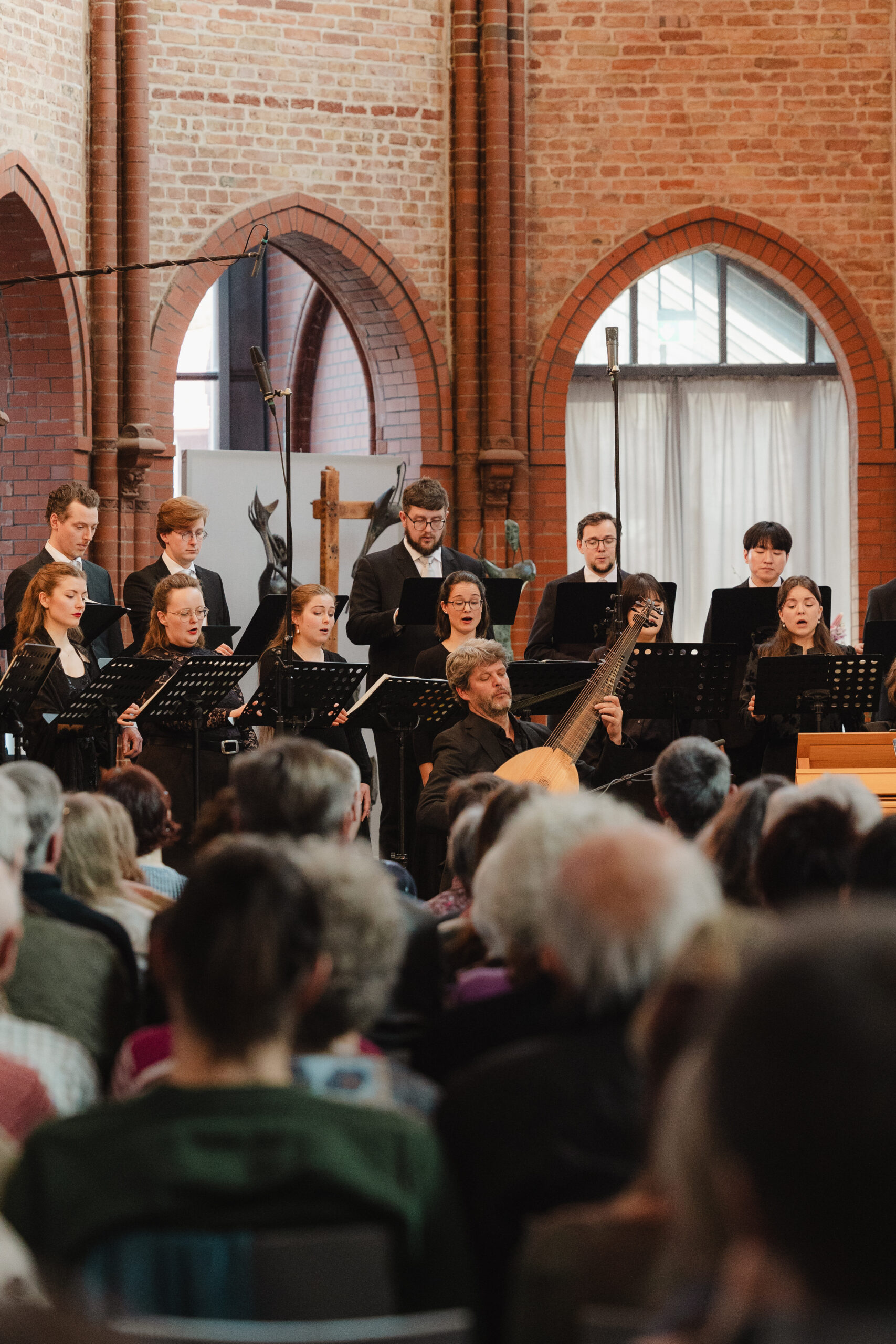
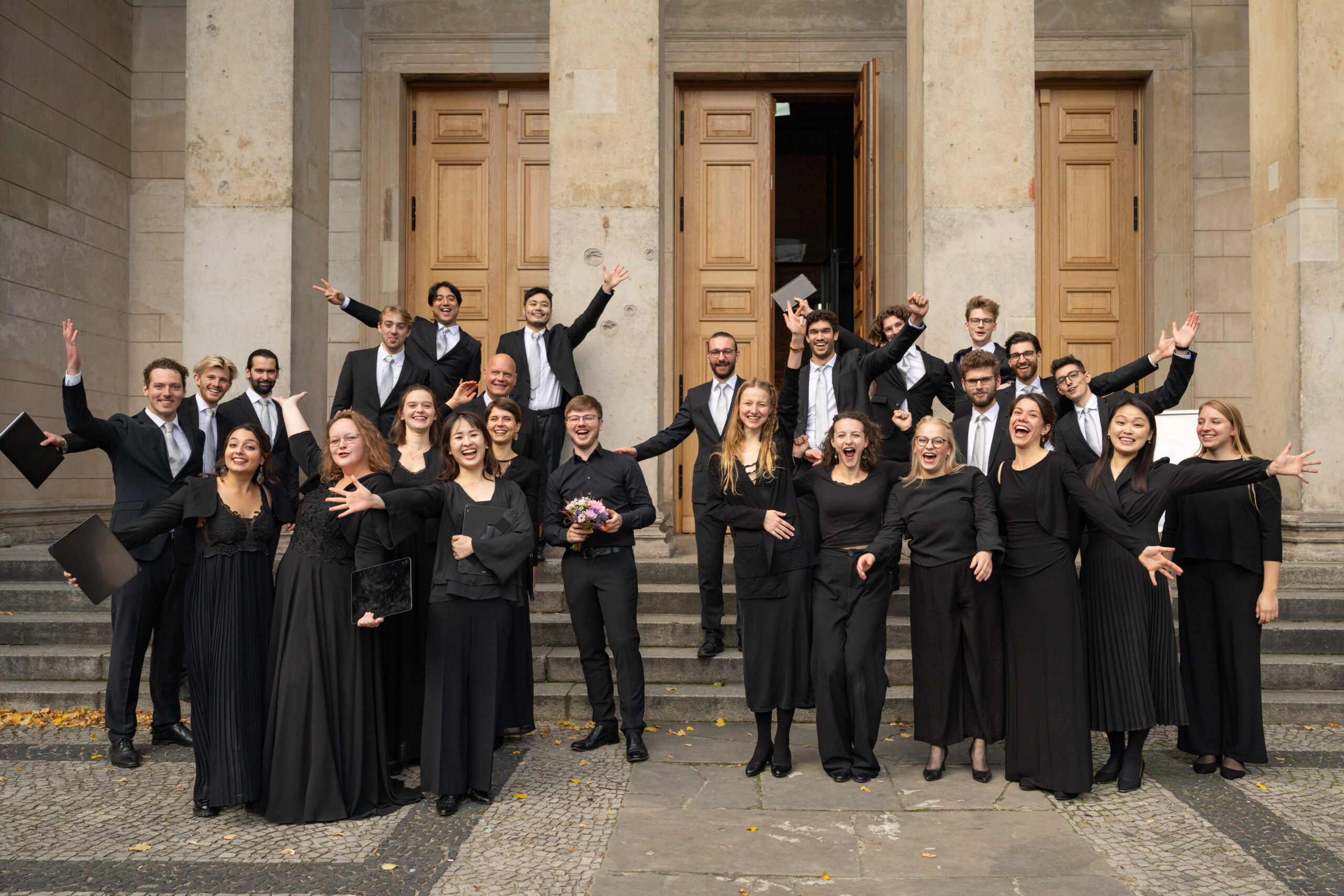
The Schola is a well-established part of our development programme for aspiring professional choral singers. Each season, up to 30 vocal students take part in a two-week intensive course, gaining first-hand experience of professional choral-symphonic work. This year, they will rehearse four major works alongside the Rundfunkchor Berlin, including Lili Boulanger’s »Du fond de l’abîme«, Stravinsky’s »Symphony of Psalms«, and Bernstein’s »Chichester Psalms«. These will be performed on 9 and 10 October at the Berlin Philharmonie, together with the Deutsches Symphonie-Orchester Berlin.
Before that, on 4 October, the Schola participants step into the spotlight in their own concert at the Heilig-Kreuz-Kirche, offering an early glimpse of their talent. As in every season, we are delighted to invite you to a special teatime concert, where the singers – under the direction of Nico Köhs and supported by members of the Rundfunkchor Berlin – will present a programme they have prepared themselves. Do join us and discover today the professional voices of tomorrow.
Remember not, Lord, our offences,
Nor th’ offences of our forefathers;
Neither take thou vengeance of our sins,
But spare us, good Lord.
Spare thy people, whom thou hast redeem’d
With thy most precious blood,
And be not angry with us for ever.
Spare us, good Lord.
Text: Litany from the »Common Book of Prayer« (1788)
Unser Wandel ist im Himmel,
von dannen wir auch warten des Heilands, Jesu Christi,
des Herren, welcher unsern nichtigen Leib verklären wird,
dass er ähnlich werde seinem verklärten Leibe,
nach der Wirkung, damit er kann auch alle Ding
ihm untertänig machen.
Text: Bible, Philippians, 3:20–21
But our citizenship is in heaven.
And we eagerly await a Savior from there, the Lord Jesus Christ,
who, by the power that enables him
to bring everything under his control,
will transform our lowly bodies
so that they will be like his glorious body.
Text: Bible, Philippians, 3:20–21
Take him, earth, for cherishing,
To thy tender breast receive him.
Body of a man I bring thee,
Noble even in its ruin.
Once was this a spirit’s dwelling,
By the breath of God created.
High the heart that here was beating,
Christ the prince of all its living.
Guard him well, the dead I give thee,
Not unmindful of his creature
Shall he ask it: he who made it
Symbol of his mystery.
Take him, earth, for cherishing.
Comes the hour God hath appointed
To fulfil the hope of men,
Then must thou, in very fashion,
What I give, return again.
Take him, earth, for cherishing.
Body of a man I bring thee.
Not though ancient time decaying
Wear away these bones to sand,
Ashes that a man might measure
In the hollow of his hand:
Not though wandering winds and idle,
Drifting through the empty sky,
Scatter dust was nerve and sinew,
Is it given to man to die.
Once again the shining road
Leads to ample Paradise;
Open are the woods again,
That the serpent lost for men.
Take, O take him, mighty leader,
Take again thy servant’s soul.
Grave his name, and pour the fragrant
Balm upon the icy stone.
Take him, earth, for cherishing,
To thy tender breast receive him.
Body of a man I bring thee,
Noble even in its ruin.
By the breath of God created.
Christ the prince of all its living.
Take, O take him,
Take him, earth, for cherishing.
Text from: Aurelius Prudentius Clemens, »Hymnus circa Exequias Defuncti«, ca. 400 AD, free English adaptation by Helen Waddell
Die mit Tränen säen,
werden mit Freuden ernten.
Sie gehen hin und weinen
und tragen edlen Samen
und kommen mit Freuden
und bringen ihre Garben.
Text: Bible, Psalm 126:5–6
They that sow in tears
shall reap in joy.
He that goes forth and weeps,
bearing precious seed,
shall doubtless come again with rejoicing,
bringing his sheaves with him.
Text: Bible, Psalm 126:5–6
Warum toben die Heiden,
und die Leute reden so vergeblich?
Die Könige im Lande lehnen sich auf,
und die Herren ratschlagen miteinander
wider den Herrn und seinen Gesalbten?
»Lasst uns zerreißen ihre Bande
und von uns werfen ihre Seile!«
Aber der im Himmel wohnet, lachet ihrer,
und der Herr spottet ihrer.
Er wird einst mit ihnen reden in seinem Zorn,
und mit seinem Grimm wird er sie schrecken:
»Aber ich habe meinen König eingesetzt
auf meinem heiligen Berge Zion.«
Ich will von einer solchen Weise predigen,
dass der Herr zu mir gesagt hat: »Du bist mein Sohn, heute habe ich dich gezeuget.
Heische von mir, so will ich dir die Heiden zum Erbe geben
und der Welt Ende zum Eigentum.
Du sollst sie mit einem eisernen Zepter zerschlagen,
wie Töpfe sollst du sie zerbrechen.«
So lasset euch nun weisen, ihr Könige,
und lasst euch züchtigen, ihr Richter auf Erden!
Dienet dem Herrn mit Furcht
und freuet euch mit Zittern!
Küsset den Sohn, dass er nicht zürne
und ihr umkommet auf dem Wege;
denn sein Zorn wird bald anbrennen.
Aber wohl allen, die auf ihn trauen!
Ehre sei dem Vater und dem Sohne
und dem Heiligen Geiste.
Wie es war von Anfang, jetzt und immerdar
und von Ewigkeit zu Ewigkeit.
Amen.
Text: Bible, Psalm 2
Why do the heathen rage,
and the people imagine a vain thing?
The kings of the earth set themselves,
and the rulers take counsel together,
against the Lord, and against his anointed,
saying, »Let us break their bands asunder,
and cast away their cords from us.«
He that sitteth in the heavens shall laugh:
the Lord shall have them in derision.
Then shall he speak unto them in his wrath,
and vex them in his sore displeasure.
»Yet have I set my king upon
my holy hill of Zion.«
I will declare the decree:
the Lord hath said unto me, »Thou art my Son; this day have I begotten thee.
Ask of me, and I shall give thee the heathen for thine inheritance,
and the uttermost parts of the earth for thy possession.
Thou shalt break them with a rod of iron;
thou shalt dash them in pieces like a potter's vessel.«
Be wise now therefore, O ye kings:
be instructed, ye judges of the earth.
Serve the Lord with fear,
and rejoice with trembling.
Kiss the Son, lest he be angry,
and ye perish from the way,
when his wrath is kindled but a little.
Blessed are all they that put their trust in him.
Glory be to the Father, and to the Son,
and to the Holy Spirit:
as it was in the beginning, is now, and ever shall be,
world without end.
Amen.
Text: Bible, Psalm 2
Faire is the heaven where happy soules have place.
In full enjoyment of felicitie;
Whence they doe still behold the glorious face
Of the Divine, Eternall Majestie;
Yet farre more faire be those bright Cherubins
Which all with golden wings are overdight.
And those eternall burning Seraphins
Which from their faces dart out fiery light;
Yet fairer than they both and much more bright
Be th’ Angels and Archangels
Which attend on God’s owne person
without rest or end.
These then in faire each other farre excelling
As to the Highest they approach more neare.
Yet is that Highest farre beyond all telling.
Fairer than all the rest which there appeare.
Though all their beauties joynd together were;
How then can mortal tongue hope to expresse
The image of such endlesse perfectnesse?
Text from: Edmund Spenser, »An Hymne in Honour of Heavenly Beautie« (1596)
In paradisum
in tuo adventu suscipiant te martyres,
in paradisum
et perducant te in civitatem sanctam Ierusalem.
Chorus angelorum te suscipiat,
et cum Lazaro, quondam paupere,
æternam habeas requiem.
Text from the antiphon »In paradisum« (as early as the 8th cent.), later to become part of liturgy for the dying or the funeral
In paradise
may the martyrs receive you at your arrival,
in paradise,
and lead you to the holy city Jerusalem.
May choirs of angels receive you
and with Lazarus, once a poor man,
may you have eternal rest.
Text from the antiphon »In paradisum« (as early as the 8th cent.), later to become part of liturgy for the dying or the funeral
Selig sind die Toten,
die in dem Herren sterben, von nun an.
Ja, der Geist spricht:
Sie ruhen von ihrer Arbeit,
und ihre Werke folgen ihnen nach.
Text: Bible, Revelation 14:13
Blessed are the dead
who die in the Lord from now on.
Yes, says the Spirit,
they will rest from their labour,
for their deeds will follow them.
Text: Bible, Revelation 14:13
The concert will be recorded by Deutschlandfunk Kultur and broadcast on 29 October at 8 pm.

Built between 1885 and 1888 in Gothic style, the Protestant Heilig-Kreuz-Kirche was extensively renovated and converted in 1995 for both ecclesiastical and secular use. The light-flooded brick church with flexible steel, glass extensions and variable seating can be used in a variety of ways for concerts, presentations, conferences, receptions and galas, accommodating up to around 430 participants. For several years, the Heilig-Kreuz-Kirche has been the permanent venue for the Schola of the Rundfunkchor Berlin. The church is centrally located in Kreuzberg on Blücherplatz, near the American Memorial Library and Potsdamer Platz.
Heilig-Kreuz-Kirche Berlin
Zossener Straße 65
10961 Berlin
Deutschland


© David Marschalsky

Bleiben Sie immer auf dem Laufenden mit aktuellen Terminen, Konzerteinblicken und Interviews