Interviews
A Word With Benjamin Goodson

Between a mood of crisis and radiant F major: in his a cappella programme »Hope«, Benjamin Goodson and the Rundfunkchor Berlin trace an arc from radical rupture to overwhelming redemption. Chief Conductor of the Netherlands Radio Choir and designated Chief Conductor of the SWR Vokalensemble, Benjamin Goodson has enjoyed a close artistic relationship with the Rundfunkchor Berlin for many years and knows its sound down to the finest nuances. On the occasion of the a cappella concert »Hope« at the Heilig‑Kreuz‑Kirche Berlin, he talks about why a Buddhist encounter convinced him of each individual’s power to effect change, how brutal dissonance can blossom into a radiant chord, why the church space becomes a secret »fellow player«, and what very personal hope he associates with this evening – topics we explore with him in our series »A Word With…«.
1. The evening is called »Hope« – when was the last time you personally thought: »Right now, I could really do with a bit of hope«?
Without immediately becoming political: at the moment it is genuinely not difficult to find reasons why one might long for hope. When I was putting the programme together, I wanted to paint a positively bold and, in a way, visionary picture of what we as human beings can achieve together. That is why the entire evening opens with the words of Jesus: »All authority in heaven and on earth has been given to me. Alleluia.« We have so much potential, so much power for good.
2. The programme features Messiaen, MacMillan, Schnittke, Schnebel, Kodály and Pärt – quite a colourful mix. If they were all sitting together at one table: what do you think they would argue about, and what would they laugh about?
What a wonderful question! I know the two living composers in the programme (MacMillan and Pärt) personally, and I can say this: they share a great gentleness, a deep faith and a distinctly mischievous sense of humour. With the others I can of course only speculate, but I have the feeling that even those who experienced a great deal of hardship still find, again and again in their music, a sense of wonder and a certain lightness. Perhaps they would argue about aesthetics, about sound, about expression, about the role of spirituality. But I also think they would laugh a great deal together.
3. How did you bring these very different musical worlds together for this evening?
Whether it is church music or not was actually not the decisive factor for me. I was more interested in a dramaturgical through‑line. From the powerful, hopeful opening we first plunge into a kind of crisis – in Schnebel into this almost insane fragmentation, in Schnittke into the insistent penitential verses. After that, for me, comes what may be our greatest opportunity: community. In the concert, the Mass stands less as a religious act in the foreground and more as a moment of shared experience, of togetherness. And then the direction shifts again. MacMillan’s »O Radiant Dawn« speaks not only of the new morning, but also of the opportunity contained in every new day. In the end, Messiaen offers an utterly overwhelming sonic vision of redemption.
4. A cappella means: nothing but voices in the space. In rehearsal, how do you know the moment has come when you get goosebumps?
That actually happened just last week, when we were working on one of the most difficult passages from the Schnittke motets. The choir suddenly sings a scale that runs through all twelve chromatic tones. At first it sounds brutally dissonant. And out of this chaos an incredibly luminous F‑major chord breaks forth. It is a fantastic moment – musically extremely demanding, but with an enormous impact. I love that.
5. If someone comes to the concert without much prior knowledge: how would you prepare them for the evening?
For me, it is truly a dream programme. I would say: read the texts, and then simply let yourself be carried by the music!
6. The Heilig‑Kreuz‑Kirche has a powerful influence on how the concert is heard. What went through your mind when you were planning for that?
It is a beautiful space. We will use different locations and formations for the choir and for the soloists, so that the audience experiences the music again and again from new perspectives. But I will not reveal any more than that. You will simply have to come and listen for yourself!
7. What do you hope will linger on in people after the concert?
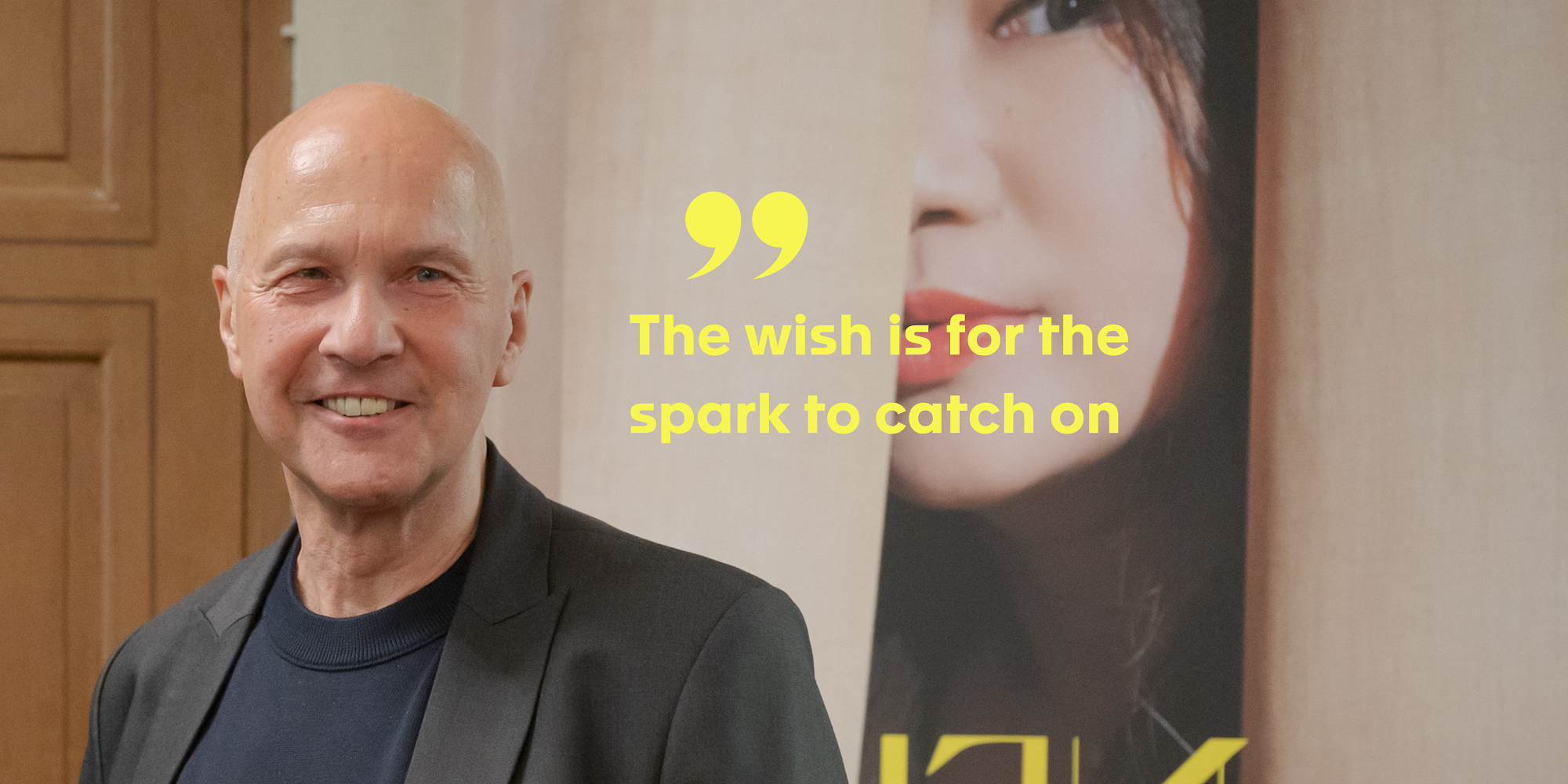
I am not religious in the narrower sense, but there was a pivotal moment in my life when I first encountered Buddhist meditation. My teacher said at the time: »Each one of you can change the world.« At first that sounded utterly absurd to me. But over time I understood what he meant. Through the practice I discovered a softer, more generous part of myself. That genuinely changed all my relationships and, to some extent at least, the people around me as well. Perhaps that is my hope for this evening: that people sense the power each and every one of us has to change our own surroundings for the better, and how far that effect can reach. It does sound a bit grand when I put it like that. But let us see what might be possible.