
Interviews, Interviews
A Word With Architect Christian Töchterle-Knuth

In 2015, architect Christian Töchterle-Knuth renovated the Helmut Koch Hall at the Haus des Rundfunks—now the Rundfunkchor Berlin’s main rehearsal space—tailoring it to the demands of daily choir work. What challenges came with the project? And how do you create truly excellent choral acoustics? Here, he shares some insights. To mark the choir’s 100th anniversary, Töchterle-Knuth will personally guide a tour of the Haus des Rundfunks during the concert »Chor im Wandel der Zeit« on 15 February 2025.
What acoustic considerations guided the design?
The hall was originally built as a recording studio for speech and radio drama—singing was never part of its intended use. Spoken word requires a very dry sound environment, where reverberation is minimal so that every syllable is clear. Choral music, by contrast, thrives on reflection and blending, and calls for reverberation times tailored to both vocal and instrumental performance.
Room dimensions
For a choir of the Rundfunkchor’s size, the Helmut Koch Hall is on the small side. Studies suggest an ideal volume of at least 30 cubic metres per singer; here, the 64 performers each have just over 27 cubic metres.
Layout and geometry
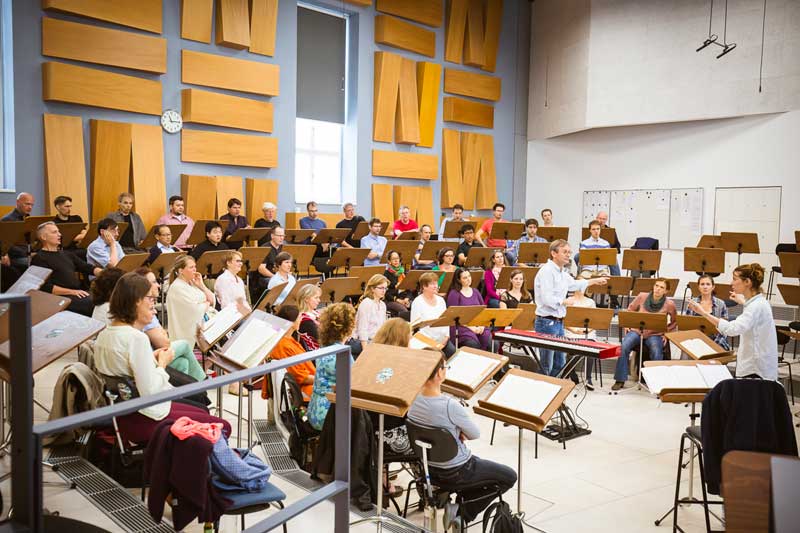
The ideal rehearsal space is trapezoidal, with balanced proportions. But the Helmut Koch Hall is too elongated, which had already caused difficulties in rehearsals before the renovation. Originally, the stage platform ran lengthwise, meaning singers—especially those furthest apart—could hardly hear each other. We explored various layouts and, in consultation with the choir’s leadership, opted for a concentric circular platform. This equalised distances between voice groups and also created a flexible area opposite the main formation for additional singers when needed.
Room acoustics
Realising the acoustic concept designed by MMT Network was tricky. Ventilation ducts had to be installed, and not all could be routed as acoustically ideal. There were conflicts between ventilation needs and acoustic requirements, but after some back and forth we managed a successful compromise. I’ll never forget the moment when construction was complete and the acoustics were tested—it was such a relief to see the measurements come out good to excellent. The hall even works well for recordings! For rehearsals in particular, the space has proven ideal: voices remain clearly distinguishable, and singers can see and hear each other perfectly. While for concerts you want a richer blend, for rehearsals this clarity is invaluable.
Sound amplification
Sound reinforcement was another key factor—and a major cost. We installed a patented system (RESPA) using laminated wood panels with milled grooves and metal inserts that amplify sound waves. Every single floor panel was engineered this way, with different formats adapted to the room’s geometry. The top layer is hard-wearing bamboo, durable enough to withstand daily use. The effect is simple but powerful: the singers’ voices carry more, making them easier to hear.
What specific challenges did you face in the existing space?
Plenty! As mentioned, the hall had been built for radio plays, with ventilation for only a handful of people. A full choir of 64 singers struggling for fresh air. We therefore designed a completely new system: fresh air now flows silently and slowly through the steps of the platform, forming a cool »pool of air« at floor level. Warmer exhaust air rises naturally to the ceiling and is drawn out.
The steel structure of the hall roof also had to be re-examined, as the original documentation didn’t specify the quality of the girders. With targeted reinforcement, we ensured full load-bearing capacity. Fire safety, too, had to be completely updated to meet modern standards.
How did you integrate the choir’s needs into the renovation?
Acoustics were at the forefront: better mutual hearing, clarity of sound, and natural resonance without electronic amplification. Since no external storage was available, we also integrated practical solutions directly into the hall: lockable lockers for singers and shelving for materials were built into existing cavities.
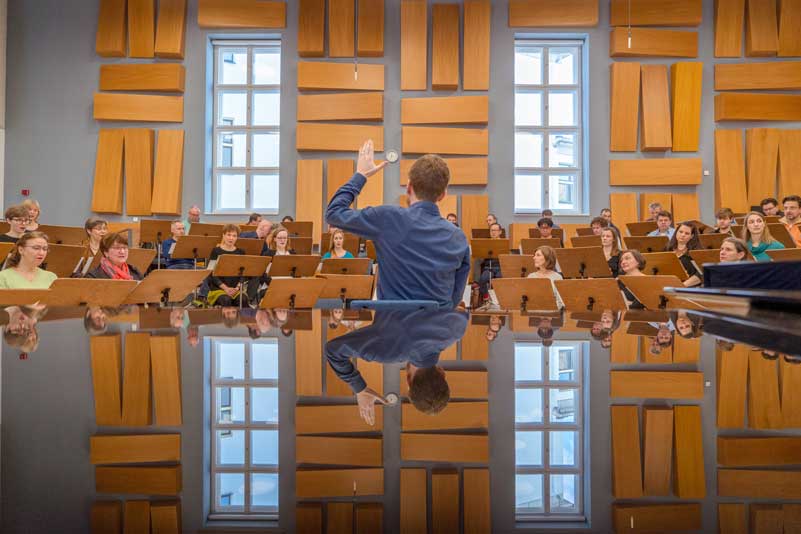
Design and atmosphere mattered, too. We refurbished and reused the hall’s original wooden sound deflectors to preserve character and warmth. The walls now combine wood with cool and warm blues, while white surfaces and floors add brightness and a black ceiling creates visual height.
Finally, we embraced what I call »organised disorder.« To avoid unwanted echoes, the hall’s dimensions vary slightly, with sloping walls. We also redesigned the arrangement of the wooden acoustic panels: instead of rigid groups of three with uneven gaps, they now hang in evenly spaced but looser patterns. This both improves acoustics and gives the hall a lighter, more open feel.
Gallery

© Peter Adamik
© Lovis Ostenrik

© Peter Adamik


